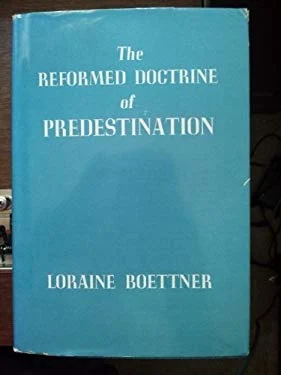
A few months before I was set to leave the Marine Corps, I decided to build up a Christian library. Every payday, I headed down to a large Christian bookstore near my base in El Toro and blew the whole check on Christian books (many of which I still have today). I sent them at a really slow book rate, so they arrived in Brooklyn a few weeks after I got out on Mach 1, 1977. I clearly remember the day I took them out of the box and put them on the shelf in my parents’ basement. One book, Lorraine Bottner’s Reformed Doctrine of Predestination, caught my eye, and I read the intro. As a young Christian with no training, much of what he said went over my head, except the last sentence:
The question which faces us then, is, Has God from all eternity foreordained all things which come to pass? If so, what evidence do we
have to that effect. and how is the fact consistent with the free agency of rational creatures and with His own perfections?
This grabbed me and would not let me go. Over the next few months, I learned about the Calvinism-Arminian debate, debated it with Fred and other Christians, and wrestled with it in my own mind. I publicly stayed on the fence for a while, but inwardly I was convinced that Calvinism was biblical. Finally, I came out of the closet and admitted to everyone that I was a Calvinist, not just a candy-store Calvinist, but a stone-cold, hard-core Calvinist who was solidly convinced the Doctrines of Grace were true.
People often ask how that jives with my Kierkegaardian existentialist Christianity. Truth is difficult to discover. Knowledge comes in many shades, and evidence varies. My knowledge of God differs from my knowledge of gravity or the sun. Faith remains in another sphere of truth, something I can hold with the utmost conviction but have no evidence of outside myself.